

Introduction: Navigating Spain’s Visa Landscape for US Professionals in 2026
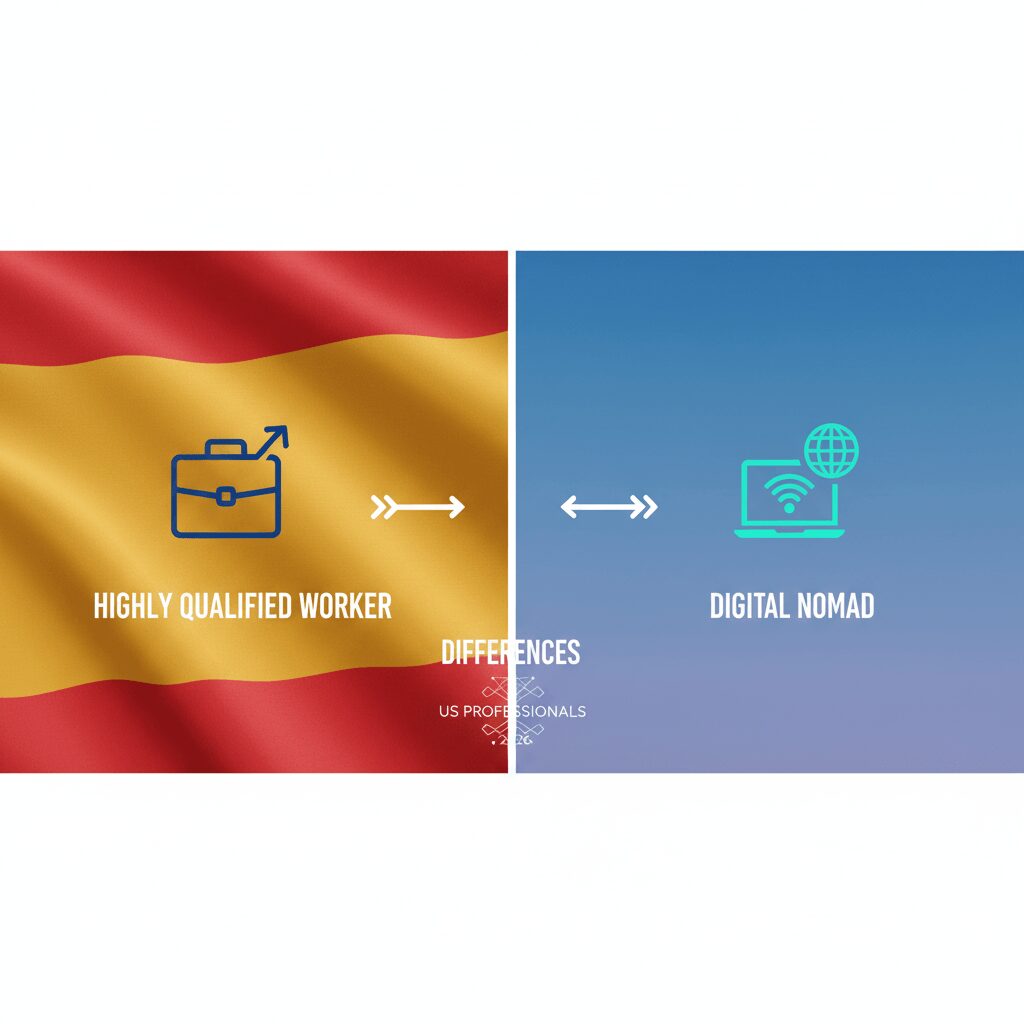
For US professionals eyeing a move to Spain in 2026, the choice between the Highly Qualified Worker Visa (HQWV) and the Digital Nomad Visa (DNV) presents a complex, yet exciting, dilemma. Both pathways offer distinct advantages, but understanding their specific requirements, implications, and long-term potential is crucial for making an informed decision. This detailed Comparison of Visa Options (Spain) aims to cut through the bureaucratic jargon, providing a strategic decision matrix tailored for professionals seeking clarity in 2026.
We’ll delve into what makes each visa unique, from eligibility criteria to long-term residency prospects, and offer expert insights to guide your journey. Whether you’re a seasoned executive or a remote freelancer, selecting the right visa foundation is paramount to your success in Spain.
Executive Summary: HQWV vs. DNV at a Glance for 2026
Below is a quick, high-level overview of the primary distinctions between Spain’s Highly Qualified Worker Visa and Digital Nomad Visa for US professionals considering immigration in 2026. This summary highlights crucial decision factors impacting your move.
|
Feature |
Highly Qualified Worker Visa (HQWV) |
Digital Nomad Visa (DNV) |
|---|---|---|
|
Primary Purpose |
Attracts highly skilled talent for Spanish companies. |
Facilitates remote work for non-EU citizens for companies outside Spain. |
|
Employer Location |
Requires a contract with a Spanish company or intra-company transfer. |
Requires employment or client contracts with companies outside Spain. Max 20% Spanish income allowed. |
|
Income Requirement (Approx. 2026) |
Linked to average national salary (typically higher, around €50,000+ annually). |
Minimum 200% of National Minimum Wage (SMI), approx. €28,000 annually. |
|
Qualification Focus |
Academic degrees, professional experience, specific high-demand roles. |
Proof of remote work capability, stable income, and employer/client relationships. |
|
Initial Validity |
Up to 3 years. |
Up to 1 year (renewable for 2 years). |
|
Path to Residency |
Clear path to permanent residency. |
Clear path to permanent residency with renewals. |
|
Beckham Law Eligibility (2026) |
Usually eligible. |
Generally eligible. |
|
Family Reunification |
Spouses, children, dependent parents. |
Spouses, children. |
This Comparison of Visa Options (Spain) serves as a foundational guide for understanding the initial differences as of 2026, pointing toward a need for deeper analysis based on your individual profile.
Strategic Decision Matrix for US Professionals: HQWV or DNV in 2026?
Choosing between the Highly Qualified Worker Visa (HQWV) and the Digital Nomad Visa (DNV) requires more than just meeting minimum criteria; it demands a strategic assessment of your 2026 career trajectory, financial stability, and long-term personal goals. This decision matrix is designed to help US professionals determine which visa aligns best with their unique circumstances.
Consider the following aspects carefully, framing them around your plans for 2026 and beyond. This self-assessment is critical for US Professionals Spain 2026 and your visa decision matrix.
-
Employment Model: Are you seeking employment directly with a Spanish company, or do you intend to continue working remotely for US-based entities or clients?
-
Income Certainty: Do you have a guaranteed, stable income from a Spanish employer, or a consistent income stream from foreign clients/employers?
-
Professional Field: Does your profession fall into a high-demand sector in Spain, or is it universally conducive to remote work?
-
Educational Background & Experience: Do you possess advanced degrees or extensive professional experience in a specialized field?
-
Family Considerations: Do you plan to bring a spouse, children, or dependent parents?
-
Long-term Residency Goals: Is your primary aim temporary work, or are you envisioning permanent residency in Spain?
-
Tax Optimization: Do you prioritize eligibility for the Beckham Law special tax regime?
Your answers to these questions will significantly influence which visa category is most appropriate for your move to Spain in 2026.
Highly Qualified Worker Visa (HQWV): Unpacking ‘Highly Qualified’ for US Applicants in 2026
The Highly Qualified Worker Visa Spain is designed to attract professionals with specialized skills to bolster strategic sectors of the Spanish economy. For US applicants in 2026, understanding what constitutes ‘highly qualified’ goes beyond a simple academic degree; it involves a confluence of education, experience, and the strategic needs of Spanish companies.
In 2026, ‘highly qualified’ definition Spain often refers to:
-
Formal Qualifications: University graduates or postgraduates.
-
Professional Experience: At least 3-5 years of relevant professional experience.
-
Key Sectors: Roles in STEM (Science, Technology, Engineering, Mathematics), IT, R&D, specialized management, finance, and certain healthcare fields are frequently targeted.
-
Salary Threshold: A salary offer from a Spanish company that typically exceeds the average national salary, confirming the specialized nature of the role. For 2026, this threshold is often above €45,000-€55,000 annually, depending on the sector and region.
Hypothetical US Professional Profiles for HQWV Eligibility:
-
Profile A: Senior Software Engineer. A US professional with a Master’s degree in Computer Science and 8 years of experience as a team lead at a Silicon Valley tech firm, offered a position by a Spanish multinational in Barcelona developing AI solutions with a salary of €65,000. This individual clearly meets the criteria for US professionals HQWV 2026 due to their specialized skills, experience, and competitive compensation.
-
Profile B: Biotechnology Researcher. A US scientist with a Ph.D. in Molecular Biology and 5 years of post-doctoral research experience, hired by a Spanish pharmaceutical company in Madrid for a leadership role in drug discovery. Their advanced academic background and specialized field make them a prime candidate for an HQWV.
The HQWV is not merely about a high salary; it’s about filling a genuine skills gap within the Spanish job market, making it particularly attractive for strategic investments and innovation.
Digital Nomad Visa (DNV): Beyond Remote Work for US Freelancers & Employees in 2026
The Digital Nomad Visa Spain 2026 caters to non-EU citizens who can work remotely. While its core concept is straightforward, its application for US freelancers Spain and remote employees Spain DNV involves several nuances, particularly concerning income verification and the nature of remote work.
Key aspects distinguishing the DNV for US applicants in 2026 include:
-
Remote Work Proof: Demonstrating that your work activities can be performed entirely remotely. This usually involves contracts with foreign companies or clients.
-
Income Requirement: You must prove a stable and sufficient monthly income. For 2026, this is typically set at 200% of Spain’s National Minimum Wage (SMI), roughly €2,500 – €2,800 per month, depending on final adjustments. Additional family members increase this threshold.
-
Client/Employer Relationship: If you’re a freelancer, you need to show multiple client contracts or a consistent client base. If employed, a letter from your US employer confirming remote work allowance and minimum one year of employment is essential.
-
Business Longevity: Freelancers typically need to prove at least three months of continuous self-employment, and employees generally need to be working for their current company for at least a year.
Hypothetical US Professional Profiles for DNV Suitability:
-
Profile C: Freelance Marketing Consultant. A US marketing professional with 7 years of experience running their own digital marketing agency, serving clients primarily in the US and Canada. They have a consistent income stream well above the DNV threshold, proven through bank statements and client contracts. This individual is an ideal candidate for the DNV.
-
Profile D: Remote Software Developer. A US software developer employed by a New York-based tech company for 3 years, with a secure remote work agreement and an annual salary of $90,000. Their employer provides a letter confirming remote work authorization. This profile perfectly fits the remote employees Spain DNV criteria.
The DNV offers significant flexibility, allowing professionals to integrate into Spanish society while maintaining ties to their international professional networks.
Application Complexities & Processing Times: A US Perspective for 2026
Both the HQWV and DNV application process US Spain can be intricate, differing in documentation requirements and the type of Spanish authority involved. Understanding these nuances is crucial for managing expectations regarding Spain visa processing times 2026 and avoiding common pitfalls.
Highly Qualified Worker Visa (HQWV) Application:
-
Complexity: Generally more complex. It often involves the Spanish employer initiating the application in Spain (Unit of Large Companies and Strategic Collective – UGE-CE), making it an intra-Spanish process before consular submission.
-
Required Documentation: Employment contract, company registration details, detailed job description, proof of qualifications, Spanish background check.
-
Processing Time: Once submitted to the UGE-CE, the resolution period is typically 10-20 business days. After approval, the visa application at the consulate is usually fast-tracked.
-
Common Pitfalls: Incomplete employer documentation, insufficient justification of ‘highly qualified’ status, delays in receiving UGE-CE approval.
Digital Nomad Visa (DNV) Application:
-
Complexity: While seemingly simpler, it requires meticulous proof of remote work, stable income, and robust foreign client/employer relationships.
-
Required Documentation: Proof of remote work (contracts, employer letters), income statements (bank statements, invoices), professional experience (CV, diplomas), foreign company details, criminal record check.
-
Processing Time: Applications submitted directly at Spanish consulates in the US generally take 15-45 days for resolution. If applying from Spain, it can be up to 20 business days.
-
Common Pitfalls: Insufficient proof of income stability, vague remote work contracts, errors in foreign company documentation, misinterpreting the 20% Spanish income rule.
For US applicants, the sheer volume of required documents and the sequential nature of obtaining certain certificates (like apostilled background checks) can significantly impact overall preparation time for both visas. The Comparison of Visa Options (Spain) reveals that while the DNV might seem more straightforward, the burden of proof for stable income and remote work rests entirely on the applicant.
Expert Insights: Navigating Bureaucracy with Spanish Immigration Lawyers (2026)
Navigating the Spanish immigration system in 2026 demands expert guidance, especially for US professionals. Spanish immigration lawyers offer invaluable assistance, particularly when dealing with the nuances of corporate sponsorships Spain for the HQWV and income verification for the DNV.
“For the Highly Qualified Worker Visa, corporate sponsorships are often a smoother path, as the Spanish company handles much of the initial groundwork within Spain,” notes a senior immigration lawyer at NIM Lawyers. “However, ensuring the employee’s profile genuinely meets the ‘highly qualified’ criteria for 2026 and accurately presenting their role to the UGE-CE is where legal expertise truly shines. We often see applications delayed due to companies misinterpreting the required salary thresholds or failing to justify the strategic value of the position.” These insights are crucial for HQWV application tips.
Regarding the Digital Nomad Visa for US citizens in 2026, another NIM Lawyers specialist advises, “Many US freelancers underestimate the strictness of income verification. Providing clear, consistent bank statements over several months, accompanied by robust client contracts or invoices, is paramount. Additionally, if you have any Spanish income, ensuring it doesn’t exceed the 20% limit is a critical compliance point.”
Engaging a reputable law firm like NIM Lawyers from the outset can save significant time and stress, ensuring all documentation is precise and compliant with 2026 regulations.
Long-Term Implications: Beckham Law, Residency & Family Pathways in 2026 and Beyond
The choice between an HQWV and DNV in 2026 extends far beyond initial entry; it significantly impacts your long-term financial planning, eligibility for special tax regimes, and pathways to permanent residency and family reunification in Spain.
Beckham Law Eligibility 2026: Tax Planning for HQWV and DNV Holders
The Beckham Law (Regimen Especial para Trabajadores Desplazados) is a special tax regime allowing eligible foreign workers to be taxed as non-residents for their first five years in Spain. This typically means a flat tax rate of 24% on Spanish-sourced income up to €600,000, and no taxation on foreign-sourced income (with some exceptions). Eligibility in 2026 for both visas is highly relevant:
-
HQWV Holders: Generally eligible for Beckham Law eligibility 2026. This is a significant draw, as it can lead to substantial tax savings compared to standard Spanish resident taxation, which can reach up to 47%. The key is that the employment must be with a Spanish entity.
-
DNV Holders: Also generally eligible. The DNV was explicitly designed to allow beneficiaries to opt into this special tax regime, provided they meet all other criteria (not being a Spanish tax resident in the previous 5 years, moving to Spain for work, etc.). The income must largely originate from outside Spain.
Both visas, therefore, offer unique tax advantages under the Beckham Law, making them attractive for US expatriates seeking tax optimization.
Spain Permanent Residency Pathway & Family Reunification
Both visas offer a pathway to permanent residency and family reunification, though with slightly different nuances:
-
HQWV Holders: After 5 years of continuous legal residency, HQWV holders can apply for long-term (permanent) residency. The family reunification Spain visa process is robust, allowing spouses, children under 21 (or older if dependent), and dependent parents to apply for co-residence.
-
DNV Holders: Similar to HQWV, after 5 years, DNV holders can apply for long-term residency. The DNV also includes provisions for family reunification for spouses and children, with clear guidelines on demonstrating sufficient financial means for dependents. Dependent parents, however, might face a more challenging path compared to the HQWV.
For both, maintaining consistent legal residency and tax compliance are critical for future applications.
Financial Advisors’ View: Expat Taxation for HQWV and DNV Holders in 2026
Understanding US expat taxation Spain 2026 is critical. US citizens are subject to taxation on worldwide income regardless of where they reside (unless they renounce citizenship). This means navigating both US and Spanish tax regimes, a process known as dual taxation. Financial planning Spain visa implications requires careful consideration.
“For both HQWV and DNV holders in 2026, the Foreign Earned Income Exclusion (FEIE) and potentially the Foreign Tax Credit (FTC) will be key mechanisms to avoid double taxation with the IRS,” states a US tax advisor specializing in expats. “HQWV holders, earning from a Spanish entity, must ensure proper Spanish payroll deductions and contributions. DNV holders, especially freelancers, must meticulously track income and expenses for both US self-employment taxes and Spanish declarations if opting for the Beckham Law. The tax implications HQWV DNV, while generally favorable under Beckham Law, still necessitate proactive tax planning to comply with both jurisdictions.”
Consulting with financial professionals familiar with US-Spain tax treaties is indispensable for maximizing benefits and ensuring compliance in 2026.
Future-Proofing Your Stay: Legislative Shifts Beyond 2026
While we focus on 2026, it’s prudent to consider potential Spain visa legislative changes beyond this year. Governments periodically review immigration policies, and while major overhauls are less frequent, minor adjustments to income thresholds, required documentation, or processing priorities can occur.
-
HQWV: As this visa targets strategic talent, its fundamental structure is likely to remain stable. Any changes might involve specific sector prioritization or adjustments to the ‘highly qualified’ definition to reflect evolving economic needs. Visa renewal Spain 2026 and beyond should remain straightforward with continued employment.
-
DNV: Given its relatively recent introduction, the DNV might see more minor adjustments. These could relate to clarity on the 20% Spanish income rule, requirements for self-employed individuals, or stricter verification of remote work legitimacy. Long-term residency Spain pathways are secure if renewal conditions met.
Staying informed through reliable sources (like official government publications and reputable immigration law firms) is the best strategy for future-proofing your stay.
Key Takeaways Box: Your 2026 Spain Visa Checklist
For US professionals eyeing Spain in 2026, this checklist summarizes critical decision points for the Comparison of Visa Options (Spain) between the Highly Qualified Worker vs Digital Nomad.
-
Assess Employment Model: Are you employed by a Spanish company (HQWV) or working remotely for non-Spanish entities (DNV)?
-
Verify Income: Do you meet the 2026 income thresholds for your chosen visa, considering dependents?
-
Evaluate Professional Profile: Does your skill set categorize you as ‘highly qualified’ for a Spanish employer, or are you a proven remote worker/freelancer?
-
Consider Long-Term Goals: How important are permanent residency and specific family reunification options for you?
-
Tax Strategy: Prioritize understanding Beckham Law eligibility for your specific visa and seek professional tax advice.
-
Documentation Preparedness: Begin gathering all necessary documents (academic, professional, financial, criminal background) well in advance.
-
Seek Expert Legal Advice: Engage specialized Spanish immigration lawyers, such as NIM Lawyers, early in the process for tailored guidance.
This 2026 Spain visa checklist will help you refine your choice and streamline your application process.
Conclusion: Making Your Informed Choice for Spain in 2026
The journey to Spain in 2026 as a US professional, whether through the Highly Qualified Worker Visa or the Digital Nomad Visa, is a strategic undertaking. This Comparison of Visa Options (Spain) highlights that there is no universally ‘better’ option; rather, the optimal choice hinges entirely on your individual circumstances, career aspirations, and long-term vision. The HQWV caters to those with specific skills seeking direct employment within Spain’s growing economy, offering a clear path for integration and competitive benefits. The DNV, conversely, champions flexibility and independence for remote workers, allowing them to immerse in Spanish culture while maintaining international professional ties.
By carefully evaluating the nuances presented in this guide, from eligibility and application complexities to long-term implications and tax considerations, you are empowered to make a truly informed decision. Remember that meticulous preparation and expert legal counsel are your greatest assets. For personalized guidance on your 2026 Spain visa decision and navigating the intricate Spanish immigration landscape, we recommend reaching out to experienced and reputable Spanish immigration lawyers, such as NIM Lawyers, who can provide tailored support for US Professionals Spain 2026.
Citations
This text references the following articles:
-
Spain: Highly Qualified Worker Visa vs EU Blue Card — “While both options help companies bring skilled professionals to Spain, they have important differences in eligibility, mobility, and validity.”
-
The Blue Card vs the Highly Qualified Work Permit — “With both permits, the residence authorisation is valid throughout Spain. The employee can legally reside and work anywhere in Spanish territory …”
-
Highly Qualified Professional Visa in Spain: Explained — “If you are a senior or highly skilled professional and want to work in Spain, the Highly Qualified Professional regime can offer faster processing, …”
-
Highly Qualified Professional (HQP/PAC) Work Permit in Spain — “The Highly Qualified Professional (HQP/PAC) route is a specialized residence and work authorization that allows non-EU citizens to live and work legally in …”
-
Spain Highly Qualified Visa : r/AmerExit — “Hi all- Has anyone gone through the process of getting a Highly Qualified Professional visa in Spain? My company is transferring me to Spain …”