

Social Security Pacts for Remote Workers and Optimizing Your ‘Social Security Spain’ Position
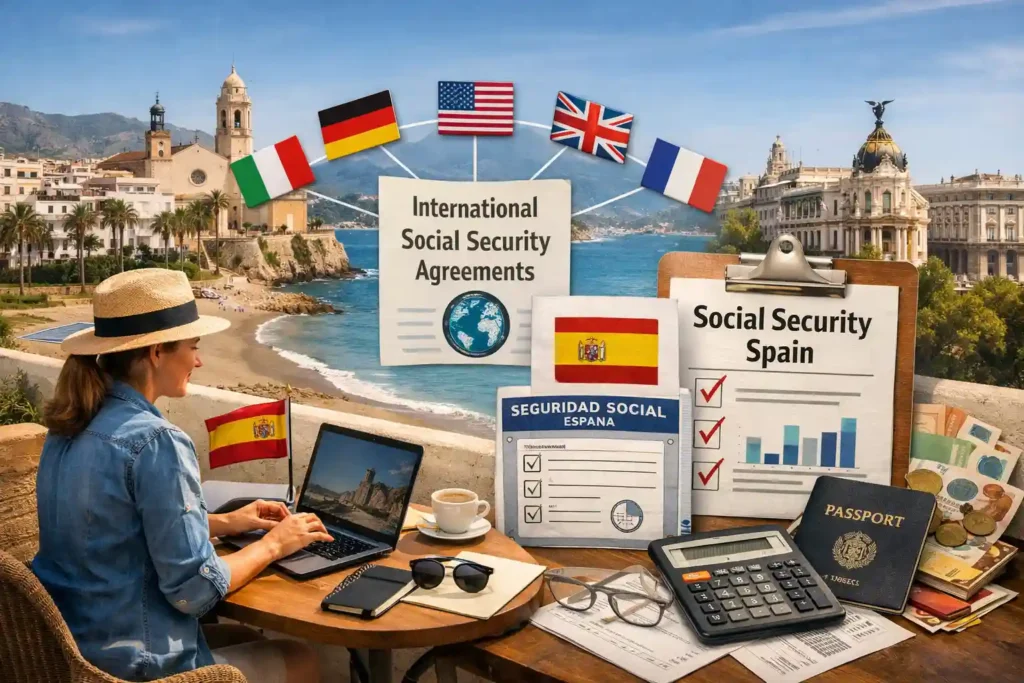
For remote workers envisioning a life in sunny Spain, navigating the country’s social security system can appear daunting. Beyond the immediate practicalities of obtaining a Social Security Number, a critical, yet frequently overlooked, aspect is the intricate network of international social security pacts. These agreements profoundly influence your contributions, benefits, and overall standing within social security Spain. This article delves deep into these essential bilateral and multilateral agreements, providing a strategic blueprint for remote professionals to optimize their social security Spain position.
Beyond the Basics: Why ‘Social Security Spain’ Pacts Matter for Remote Workers
Understanding international social security agreements is paramount for any remote worker in Spain. These pacts are not mere bureaucratic footnotes; they are the bedrock upon which your financial security and access to essential services are built. For those unfamiliar, Spain has signed numerous agreements with countries worldwide, designed to coordinate social security systems.
The Overlooked Landscape of International Agreements and ‘Social Security Spain’
When a remote worker from, say, the United States, Canada, or an EU member state, begins working from Spain, they enter a complex multi-jurisdictional environment. Without these agreements, individuals could face significant challenges, including paying social security contributions in two countries simultaneously or losing credited periods of contributions made abroad. These treaties harmonize diverse national regulations, specifically impacting your social security Spain obligations.
What Traditional Guides Miss: The Pact-Driven Advantages for Your ‘Social Security Spain’
Many guides focus on general Spanish social security requirements. However, they often miss the strategic advantages offered by these international pacts. This article distinguishes itself by focusing on the legal frameworks that explicitly prevent double contributions, facilitate the aggregation of insurance periods, and ensure the portability of social security rights. These advantages directly influence a remote worker’s social security Spain standing, offering protection and clarity where confusion might otherwise reign.
Deconstructing Double Burdens: How Pacts Prevent Duplicate ‘Social Security Spain’ Contributions
One of the most significant benefits of social security pacts is the prevention of double contributions. Remote workers might otherwise be liable to pay social security in both their home country and Spain. These agreements contain specific provisions designed to alleviate this financial burden, directly clarifying your obligations to social security Spain.
Understanding the ‘Detachment’ Principle in ‘Social Security Spain’ Treaties
The concept of ‘detachment,’ often referred to as ‘posted worker’ status, is central to preventing double contributions. Under this principle, an individual temporarily working in Spain for an employer based in their home country (or as a self-employed individual typically working from their home country) may remain exclusively subject to their home country’s social security system. This typically avoids the obligation to contribute to social security Spain. This status is usually certified by specific forms, such as the A1 for EU/EEA/Switzerland/UK or Certificates of Coverage for other treaty partners.
Case Study 1: US Remote Worker & The US-Spain Totalization Agreement for ‘Social Security Spain’
Consider a US citizen, Sarah, based in Spain as a remote worker for a California-based tech company. Without a Totalization Agreement, Sarah might be required to contribute to both the US Social Security system and social security Spain. However, the US-Spain Totalization Agreement allows Sarah to obtain a Certificate of Coverage from the US Social Security Administration. This certificate confirms her continued coverage under the US system, exempting her from mandatory contributions to social security Spain for a specific period (typically up to five years, extendable in some cases). This prevents a double burden while she works remotely from Spain.
Case Study 2: Canadian Remote Professional Navigating the Canada-Spain Agreement on ‘Social Security Spain’
John, a self-employed Canadian graphic designer, moves to Spain to work remotely for his clients back in Canada. Both Canada and Spain have a bilateral social security agreement. Under this agreement, John can apply to the Canadian authorities for a Certificate of Coverage, attesting that he continues to contribute to the Canada Pension Plan and Employment Insurance. This certificate prevents him from having to pay into social security Spain as a self-employed individual. The agreement streamlines his social security obligations, ensuring consistency across borders.
Aggregating Your Future: Portability of Rights and Contribution Periods for ‘Social Security Spain’
Beyond preventing double contributions, social security pacts are crucial for the long-term aggregation and portability of rights. This ensures that your contributions, wherever they are made, can count towards future benefits, affecting your access to pensions, healthcare, and unemployment benefits under social security Spain frameworks.
Counting Your Years: Harmonizing Contribution Periods towards ‘Social Security Spain’ Benefits
The aggregation principle means that if you have worked and contributed to the social security systems of several signatory countries, those periods can be combined to meet the eligibility criteria for benefits in one of those countries. For example, if you need 15 years of contributions to qualify for a Spanish retirement pension, and you have 10 years in Germany and 5 years in Spain, these periods can often be aggregated under EU regulations to meet the social security Spain requirement. This prevents the loss of accrued social security rights due to international mobility.
Ensuring Seamless Healthcare Access Via ‘Social Security Spain’ Agreements
These pacts significantly simplify healthcare access for remote workers. For EU/EEA/Switzerland/UK citizens, the S1 form is a prime example. If you are covered by your home country’s social security system (e.g., through ‘detachment’), you can obtain an S1 form from your national health authority. This form then registers you for healthcare coverage in Spain, linking your care to your home country’s system without requiring direct contributions to social security Spain for healthcare purposes. This ensures continuous and seamless medical provision during your remote work stay.
Portability of Pensions: Securing Your Retirement with ‘Social Security Spain’ Pacts
Perhaps one of the most vital aspects for long-term planning is pension portability. Social security agreements ensure that your contributions made abroad are not lost. They allow periods of coverage in different countries to be added together for the purpose of determining eligibility for retirement, disability, and survivor benefits. This means that years contributed to, for example, the US Social Security system can be recognized by social security Spain when determining your eligibility for a Spanish pension, and vice-versa, preventing the erosion of your retirement savings due to cross-border work.
Expert Insight: ‘Social Security Spain’ Through the Lens of Cross-Border Employment Lawyers
“Navigating international social security can be a minefield without understanding the applicable bilateral or multilateral agreements,” states Elena Gómez, a lawyer specializing in cross-border employment. “For remote workers, these pacts are not just about compliance; they are about strategic financial planning. Failing to leverage a Totalization Agreement or an A1 certificate can lead to significant overpayments or, worse, a forfeiture of benefits down the line. It’s crucial to identify your specific situation and apply the correct administrative procedures to maximize the benefits provided by these agreements regarding social security Spain.”
Strategic Residency & ‘Social Security Spain’: Digital Nomad Visa vs. Other Paths
The type of residency you hold in Spain significantly influences how social security pacts apply to your social security Spain obligations. The advent of the Digital Nomad Visa (DNV) has introduced new nuances.
The Digital Nomad Visa and Its Specific ‘Social Security Spain’ Considerations
The Digital Nomad Visa (DNV) in Spain offers specific tax advantages but also has particular implications for social security Spain. DNV holders, by definition, work remotely for companies outside Spain. This status often aligns perfectly with the ‘detachment’ principles within social security pacts. If a DNV holder is from a country with a social security agreement with Spain (e.g., US, Canada, EU), they can frequently leverage the ‘posted worker’ provisions to continue contributing to their home country’s social security system. This typically exempts them from direct contributions to social security Spain, provided they meet the specific criteria and duration limits of the agreement.
Comparing Residency Routes: ‘Social Security Spain’ Differences for DNV vs. Self-Employed Visas
Consider the contrast: a DNV holder (working for a single, non-Spanish entity) versus a self-employed visa holder (working for multiple clients, potentially including Spanish ones). A self-employed individual on a standard visa might be fully obligated to contribute to social security Spain as autónomo from day one. However, a DNV holder from a treaty country often has the option to remain under their home system for an initial period, thanks to these pacts. This offers a significant difference in immediate contribution requirements and access to benefits under social security Spain for the initial years.
Optimizing Your ‘Social Security Spain’ Position Based on Your Residency Status
Strategic planning is key. If your intent is a long-term stay in Spain, understanding how periods of ‘detachment’ (under a DNV) might transition into direct contributions to social security Spain is vital. For example, after the initial period of ‘detachment’ allowed by a pact, a DNV holder might need to re-evaluate their social security status and potentially begin contributing to the Spanish system. Choosing the right residency path and understanding its interaction with social security agreements allows remote workers to optimize their compliance and financial security regarding social security Spain.
Navigating the Agreements: A Practical Guide to Leveraging Your ‘Social Security Spain’ Pacts
Leveraging social security pacts requires a proactive approach. This practical guide outlines the steps remote workers should take to identify, understand, and apply the provisions relevant to their specific social security Spain situation.
Step 1: Identifying the Applicable ‘Social Security Spain’ Agreement
The first step is to determine which agreement, if any, applies to you. This hinges on your nationality and the country where your employer is based (or where you usually contribute as self-employed).
* For EU/EEA/Switzerland/UK citizens: Regulation (EC) No 883/2004 (and its implementing regulation No 987/2009 for the EU/EEA/Switzerland, and the Trade and Cooperation Agreement for the UK post-Brexit) provides the multilateral framework.
* For other nationalities: Check the list of bilateral social security agreements Spain has signed. Key countries include the US, Canada, Australia, Japan, and several Latin American nations. The Spanish Ministry of Inclusion, Social Security, and Migration (Ministerio de Inclusión, Seguridad Social y Migraciones) maintains an updated list.
Step 2: Decoding Key Articles for Your Remote Work ‘Social Security Spain’
Once you identify the applicable agreement, a deeper dive into its specific articles is necessary.
* US-Spain Totalization Agreement: Article 7 often addresses ‘detached workers’, outlining conditions for continued US coverage. Example: “An employee who is covered under the laws of one Contracting State and is sent by an employer in that Contracting State to work for that employer in the other Contracting State shall remain subject only to the laws of the first Contracting State for a period not to exceed five years.”
* Canada-Spain Social Security Agreement: Similar articles often detail the scope of employees temporarily posted abroad.
* EU Regulation 883/2004 (Article 12): This is crucial for EU citizens, stipulating that a person pursuing an activity as an employed or self-employed person in a Member State on behalf of an employer or on their own account and who is posted by that employer or by themselves to another Member State to perform work there shall continue to be subject to the legislation of the first Member State, provided that the anticipated duration of that work does not exceed 24 months.
These articles define the duration of ‘detachment’, the conditions for extension, and the types of work covered, directly impacting your social security Spain contributions.
Step 3: Required Documentation and Application Process for Your ‘Social Security Spain’ Benefits
To invoke the provisions of these pacts, specific documentation is required:
* Certificate of Coverage: For agreements like the US Totalization Agreement, you’ll need to apply for a Certificate of Coverage (e.g., Form US/SP 1 for the US-Spain agreement) from your home country’s social security administration.
* A1 Certificate: For EU/EEA/Switzerland/UK nationals, this certificate confirms your continued coverage under your home country’s social security system for up to 24 months (or longer with approval). You apply for this through your domestic social security institution.
* Submitting Documentation: Once obtained, these certificates must be presented to the Spanish Social Security Institute (Instituto Nacional de la Seguridad Social – INSS) or the General Treasury of Social Security (Tesorería General de la Seguridad Social – TGSS) to formally exempt you from social security Spain contributions for the specified period.
Real-World Application: Success Stories in Optimizing ‘Social Security Spain’ Through Pacts
Maria, a German IT consultant, moved to Valencia on a Digital Nomad Visa. By securing an A1 certificate from Germany, she avoided contributing to social security Spain for her first two years, continuing her German contributions. This saved her significant money and ensured continuity of healthcare coverage through her German system, which seamlessly extended to Spain via the S1 form.
Similarly, Alex, an Australian content creator working remotely, leveraged the Australia-Spain social security agreement. He applied for a Certificate of Coverage from Services Australia, exempting him from contributing to social security Spain for his first few years, allowing him to focus on growing his business while maintaining his Australian social security standing. These examples underscore the tangible benefits of proactively engaging with these agreements to manage your social security Spain position.
Conclusion: Master Your ‘Social Security Spain’ Journey with Strategic Pact Utilization
Navigating the complexities of social security Spain as a remote worker requires a nuanced understanding that extends beyond basic obligations. International social security pacts are invaluable tools, offering frameworks to prevent double taxation, aggregate contribution periods, and ensure the portability of your benefits—from pensions to healthcare. By strategically identifying and leveraging these agreements, remote professionals can optimize their financial security, ensure compliance, and unlock the full potential of their remote work journey in Spain. Don’t simply migrate; strategize your social security Spain future.