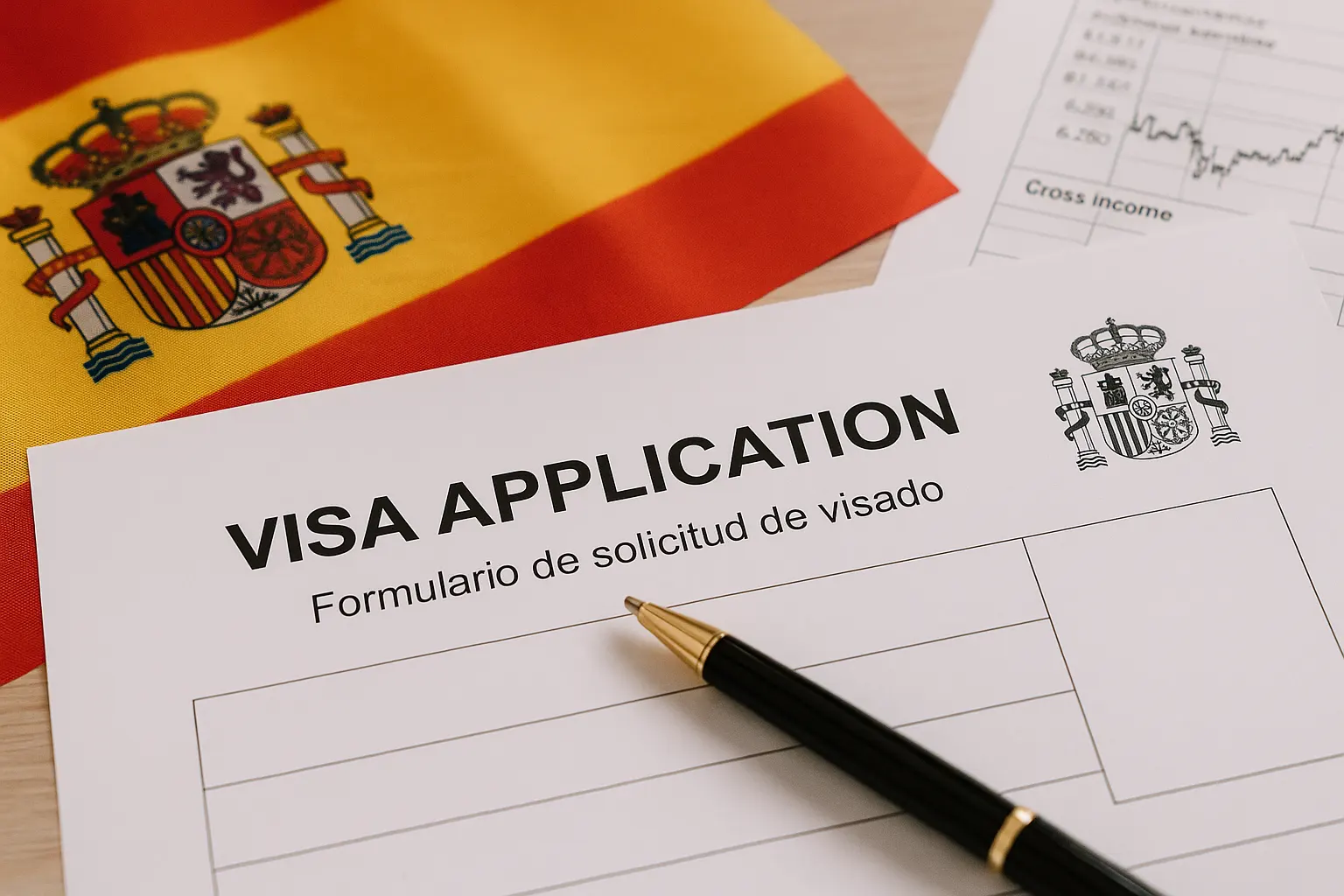

Navigating the intricacies of international remote work for American companies with employees choosing Spain as their base can be a complex undertaking. The allure of Spain’s rich culture, beautiful landscapes, and vibrant lifestyle is undeniable, making it an increasingly popular destination for digital nomads and remote workers. However, for a US company, facilitating such an arrangement involves a labyrinth of legal, tax, and social security considerations that differ significantly from domestic operations.
TL;DR
-
US companies face significant legal and financial complexities when employees work remotely from Spain.
-
The Spanish Digital Nomad Visa (DNV) is a key pathway for non-EU citizens, including Americans, to work remotely from Spain in 2026.
-
Understanding Spanish tax residency rules, social security obligations, and permanent establishment risks is crucial.
-
Compliance with both US and Spanish labour laws is essential to avoid penalties.
-
Seeking expert legal and tax advice is highly recommended for smooth and compliant operations.
Introduction
The global shift towards remote work has opened up unprecedented opportunities for employees to choose their workplace, and for many Americans, Spain presents an incredibly attractive option. The Mediterranean climate, the vibrant culture, and the lower cost of living compared to many US cities are powerful draws. However, for US companies looking to accommodate these preferences, simply allowing an employee to pack their bags and work from Barcelona or Seville isn’t a straightforward process in 2026.
This comprehensive guide provides clear and practical information for American companies navigating the legal and operational landscape of remote work arrangements from Spain. We will delve into the essential considerations, from visa requirements and tax implications to social security contributions and potential permanent establishment risks. Our aim is to demystify these complex topics, offering a structured approach to ensure compliance and facilitate a seamless remote work experience for both the company and the employee.
Understanding the Legal Framework for Remote Work in Spain
The Digital Nomad Visa (DNV) Spain: A Key Pathway in 2026
For US citizens, the primary and most streamlined route for legitimately working remotely from Spain for a non-Spanish company is the Digital Nomad Visa (DNV), introduced under the Spanish Startup Act of 2022. This visa is specifically designed for non-EU/EEA nationals who wish to live and work remotely in Spain for companies outside of Spain. It’s an essential consideration for American companies with remote employees in Spain in 2026.
This visa opens up exciting opportunities for those looking to embrace the lifestyle of a digital nomad in Europe, especially with Spain’s Digital Nomad Visa for US citizens.
Eligibility Criteria for the DNV:
-
Non-EU/EEA Nationality: Open to citizens of third countries, including the United States.
-
Remote Work Contract: The applicant must have an existing employment relationship or professional activity with one or more foreign companies for at least three months prior to the application.
-
Company Activity: The company or companies must allow remote work.
-
Professional Experience or Qualifications: Demonstrable professional experience of at least three years, or a graduate/postgraduate degree from a recognised university, or professional training qualifications.
-
Sufficient Financial Means: Applicants must prove they have sufficient economic means to support themselves and their families (if applicable) in Spain. For 2026, this threshold is generally 200% of the minimum interprofessional salary (SMI) for the main applicant, plus additional percentages for dependants.
-
Clean Criminal Record: Required from all countries where the applicant has resided in the past two years.
-
Private Health Insurance: Must cover a minimum level of care in Spain, equivalent to the Spanish public health system.
Application Process for the DNV:
-
Initial Application: Can be submitted from the US (through the Spanish Consulate) or from Spain (if the applicant is already legally present in Spain).
-
Required Documentation: This typically includes passport, proof of financial means, employment contract/company letter confirming remote work, academic/professional certificates, criminal record certificates, health insurance, and the application form (Modelo EX-00).
-
Resolution Period: Timelines can vary, but authorities generally aim to resolve DNV applications within 20 working days.
-
Residency Permit: Upon approval, a temporary residence permit (Tarjeta de Identidad de Extranjero – TIE) valid for up to three years is granted, renewable for two-year periods.
It’s crucial for American companies to understand that encouraging an employee to simply travel to Spain on a tourist visa and work remotely is illegal and can lead to significant issues for both the employee (deportation, re-entry bans) and potentially the company (reputational damage, legal challenges).
Tax Implications for US Companies and Employees in Spain
Employee Tax Residency in Spain
The moment an American employee establishes tax residency in Spain, they become subject to Spanish tax laws. An individual is generally considered a tax resident in Spain if they spend more than 183 days in a calendar year in the country, or if Spain is deemed their ‘centre of vital interests’ (e.g., their permanent home, family). Tax residents in Spain are taxed on their worldwide income.
The DNV offers a favourable tax regime for its holders, allowing them to opt for the Special Tax Regime for Impatriates, commonly known as the “Beckham Law.” Under this regime, eligible individuals are taxed as non-residents for their first six years in Spain. This means their income derived from work carried out in Spain is taxed at a flat rate of 24% on the first 600,000 EUR, rather than progressive rates which can go up to 47% or more. Salary paid from the US for work carried out in Spain is still taxed in Spain under this regime, because all employment income is deemed to be obtained in Spain.
However, it is paramount that employees correctly opt into this regime, typically within six months of registering with Social Security in Spain.
Permanent Establishment (PE) Risk for US Companies
One of the most significant concerns for American companies is the risk of creating a “Permanent Establishment” (PE) in Spain. If a US company is deemed to have a PE in Spain, it becomes subject to Spanish corporate tax laws on the profits attributable to that PE. This significantly increases the company’s administrative and financial burden.
Historically, merely having a remote employee in a country did not automatically trigger a PE. However, tax authorities globally are increasingly scrutinising these arrangements in the wake of widespread remote work. While the tax treaty between the US and Spain provides guidance, factors that could contribute to a PE include:
-
The employee having authority to conclude contracts in Spain on behalf of the company.
-
The employee consistently carrying out activities in Spain that form the core business of the company.
-
The employee using an office or fixed place of business provided by the company in Spain.
The DNV framework aims to mitigate some of these PE risks by explicitly stating that the mere presence of a remote worker under this visa does not automatically constitute a permanent establishment in Spain for the employer, provided the employee works for a foreign company and does not actively conduct business in Spain that creates added value for a Spanish entity. Nevertheless, careful consideration and professional advice are essential to ensure compliance and structured operations that minimise PE risk for American companies in 2026.
Social Security Obligations
Social security contributions are another critical area. Generally, if an employee is working from Spain, they should be contributing to the Spanish social security system. Spain has a comprehensive social security system that covers healthcare, unemployment benefits, and pensions.
Totalisation Agreement with the US
The good news is that the United States and Spain have a Totalisation Agreement. This agreement prevents dual social security coverage and double contributions for workers who have worked in both countries. Generally, it means that if an employee is working temporarily in Spain (usually for up to five years) for a US employer and continues to be covered by the US Social Security system, they may be exempt from Spanish social security contributions, provided certain conditions are met and a Certificate of Coverage (form US/Spain 1) is obtained from the US Social Security Administration.
However, if the employee is intended to reside in Spain for an extended period beyond the typical Totalisation Agreement limits, or if they are not covered by the US system, they will likely need to register with the Spanish Social Security system (Seguridad Social) and contribute accordingly. An employee cannot simply register as self-employed (autónomo) for convenience, as this would be an improper registration. Employees must be registered as employees, for example through a Spanish entity or an employer of record.
Labour Law Considerations
Even if an American employee is primarily subject to US employment contract terms, Spanish labour laws may still partially apply, especially regarding health and safety, working hours, annual leave, and termination procedures, particularly if the employee is considered to be habitually working in Spain. This can pose complexities for US companies unfamiliar with Spanish labour code. This is where an Employer of Record (EOR) service can be particularly beneficial, handling all Spanish labour law compliance on behalf of the US company.
Options for US Companies to Engage Remote Workers in Spain
Direct Employment (with extreme caution)
This is generally the most challenging and least recommended option without establishing a legal entity in Spain. If a US company directly employs someone in Spain without a Spanish legal presence, it risks creating a permanent establishment and has significant hurdles regarding payroll, tax withholding, and social security contributions. The company would effectively need to comply with Spanish payroll, tax, and labour laws as if it were a Spanish employer, which is administratively burdensome and legally risky.
Independent Contractor
Engaging the American remote worker as an independent contractor in Spain is a common approach. The worker would register as a self-employed individual (autónomo) in Spain, obtain a NIE (Número de Identificación de Extranjero), and issue invoices to the US company. This simplifies payroll for the US company, as the contractor is responsible for their own tax and social security contributions in Spain.
However, it is crucial to ensure that the employment relationship genuinely qualifies as independent contractor status under Spanish law. Misclassifying an employee as an independent contractor can lead to severe penalties for the US company, including back taxes, social security contributions, and fines. Spanish labour law is particularly protective of employees, and criteria for independent contractor status are strictly interpreted.
Employer of Record (EOR) Service
For many American companies, using an Employer of Record (EOR) service is the most practical and compliant solution. An EOR is a third-party organisation that legally employs the worker in Spain on behalf of the US company, handling all aspects of local compliance, including:
-
Spanish payroll processing.
-
Withholding and remitting Spanish income tax (IRPF).
-
Managing social security contributions.
-
Ensuring compliance with Spanish labour laws (contracts, holidays, termination, etc.).
-
Handling HR administration in Spain.
The US company retains full control over the employee’s day-to-day tasks and performance, while the EOR manages the legal and administrative complexities of employment in Spain. This option effectively mitigates PE risk and ensures full compliance without the need for the US company to establish its own entity in Spain.
Key Steps for US Companies in 2026
-
Assess Employee’s Intent: Confirm the employee’s long-term plans in Spain and their eligibility for the Digital Nomad Visa.
-
Legal and Tax Consultation: Engage with Spanish legal and tax experts to understand the specific implications for both the company and the employee. This is paramount to avoiding costly mistakes.
-
Choose Engagement Model: Decide whether to opt for an independent contractor model (if truly applicable) or an EOR service. The latter is often the safest and most efficient path.
-
Support DNV Application: Provide necessary documentation for the employee’s DNV application (e.g., employment contract, letter confirming remote work).
-
Ensure Social Security Compliance: If using a direct employment model, explore the US-Spain Totalisation Agreement. If using an EOR, they will manage this. If the employee is an autónomo, they manage it themselves.
-
Review Company Policies: Adapt or create new company policies to align with Spanish working hour regulations, holidays, and other relevant labour laws if directly employing, or understand how the EOR service will integrate with existing policies.
-
Cybersecurity and Data Protection: Ensure robust cybersecurity measures and compliance with GDPR (General Data Protection Regulation) for employees working from Spain, as they will be handling data within the EU.
Key Takeaways
-
The Spanish Digital Nomad Visa is the primary legitimate route for US remote workers in Spain in 2026.
-
US companies must understand Spanish tax residency rules, especially the “Beckham Law” option for DNV holders.
-
Mitigating Permanent Establishment (PE) risk is crucial for US companies operating with remote employees in Spain.
-
Social Security compliance is complex but can be managed via the US-Spain Totalisation Agreement or through an EOR.
-
Utilising an Employer of Record (EOR) service is often the most secure and compliant method for US companies to engage remote workers in Spain.
-
Expert legal and tax advice from professionals specialising in Spanish and international law is indispensable.
Authority Sources
-
Spanish Ministry of Inclusion, Social Security and Migrations (Ministerio de Inclusión, Seguridad Social y Migraciones)
-
Spanish Tax Agency (Agencia Tributaria / AEAT)
-
Spanish Ministry of Foreign Affairs (Ministerio de Asuntos Exteriores, Unión Europea y Cooperación)
-
Social Security Administration (SSA) – United States
Contact Us Today
Navigating the complexities of international remote work requires specialised knowledge and meticulous planning. If your American company is considering or currently managing remote work arrangements from Spain in 2026, don’t leave compliance to chance. Contact us today for expert guidance tailored to your specific needs, ensuring your operations are seamless, compliant, and beneficial for both your company and your valued employees.
Citations
This text references the following articles:
-
Spain Digital Nomad Visa for Remote Employees: W-2 Worker’s Guide — “Understand how Spain’s Digital Nomad Visa works for W-2 employees and prepare your employer documents, taxes, and Social Security correctly.”
-
We are a US based company and have an employee that wants to … — “When a US-based employee moves to Spain, they generally need a valid visa or residence permit to live and work there legally. From the company’s …”
-
Leave Laws and Holidays in Spain: A Guide for US Companies — “Interested in expanding your US company to Spain? Read our guide to learn about leave laws and policies in Spain, in preparation for hiring …”
-
How To Hire Employees In Spain – Papaya Global — “This comprehensive guide details everything needed to understand the process of hiring employees in Spain, from interpreting labor laws to effectively sourcing …”
-
Working remotely from Spain for a US role [closed] — “The company will have to figure out how to navigate both Spanish and US laws concerning your employment. They may have to run a special payroll …”